Extrinsic Value: this is what makes stock options so risky...
The extrinsic value (time value) of an option is the dollar value that is placed on the remaining life of the option.
Extrinsic or time value is similar to how the life insurance industry attaches a dollar figure to the estimated remaining years of your life. This dollar figure is what they use to create your insurance "premium".
It's slightly more complicated than that, but I think you get the point.
Well the time left until a stock option expires is given a dollar value and this is placed into the "premium" (cost) of the option along with the 5 other factors that we discussed in the stock option valuation lesson.
Extrinsic Value is also called time value. You will hear both terms used.
Extrinsic Value and its Effect on Option Pricing...
Simply put, here is the effect that time value has on option price: the longer the time until expiration, the greater the cost of the option. An option with more days left until expiration will cost more than an option with fewer days left until expiration.
An option with three months left until expiration has more time than an option that expires in two weeks.
There is a greater chance the stock will move significantly over the span of three months then it will in two weeks (so you're essentially paying for that time).
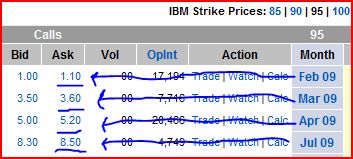
Below is a snapshot of an option chain showing you how the cost of the option increases the further out in "time" (expiration month) you go.
The picture is of an IBM 95 Call Option. The strike price is $95. The arrows point to the cost of the February 95, March 95, April 95, and July 95 Call option.
What Happens if the Stock Doesn't Move?
Suppose you buy an option with 3 months left until expiration. You have paid for 3 months worth of time.
If the stock doesn't move for a month and stays at the same price, then the value of your option will be worth less then when you bought it (it will decrease in value).
This is because the time value has been eroding away.
You now have only two months of value left in the options price. This is called: time decay.
This is also why options are often called "wasting assets", and is part of what makes them risky.
With stocks you can hold onto them forever waiting for them to move in the desired direction. With options, the moment you buy them the clock starts ticking. The stock "must" move, or you will start losing money.
As a trader you have to be disciplined and thorough in your research. You want to pick the best stocks poised to make a move in a relatively short period of time.
The Passive Stock Options Trading Book Series
Discover how to achieve financial freedom in only 5 years...
Read what others have to say about the book. [Amazon affiliate link]
If You're Looking For A Reliable Lower Risk Way To Be
Profitable With Options, Try The "Buffett Strategy"...
I don't know what has brought you to my page. Maybe you are interested in options to help you reduce the risk of your other stock market holdings.
Maybe you are looking for a way to generate a little additional income for retirement. Or maybe you've just heard about options, you're not sure what they are, and you want a simple step-by-step guide to understanding them and getting started with them.
I have no idea if options are even right for you, but I do promise to show you what has worked for me and the exact steps I've taken to use them to earn additional income, protect my investments, and to experience freedom in my life.
If you want to learn more, I invite you to download a FREE video case study on how to trade options like Warren Buffett.
Inside you will discover...
- How investors pay me money to buy their stock.
- How "combining option selling with option buying" resulted in a 60% growth of my account.
- The "Family Freedom Fund" strategy I use to beat the market each year (I'm an experienced investor so your results may vary).
- And lastly, there is a high risk way to trade options and a low risk way. You'll discover a low risk "sleep well at night" method of investing.
Fill in your details below to download your FREE case study. Along with your case study, you'll also get my daily emails where I share my favorite option trading strategies, examples of the trades I'm currently in, and ways to protect your investments in any market.
Wealth Building Resources
Free Video Case Study (Newsletter)
Options Trading Made Simple Book (My Kindle book)
Options Wealth Academy (High End Training Program co-founded by Travis)
Free Options Course Learning Modules
|
Module 1: Option Basics |
Module 2: Option Value |
Module 3: Basic Strategies |
|
Module 4: Stock Charts |
Module 5: Technical Indicators |
Module 6: The 7-step process I use to trade stock options |
Learn Stock Options Trading Home Page
