"Stock Options Trading Gives Investors Financial Freedom Because it Allows You to Have an Income Source That YOU Control..."
Stock options trading helps investors who are tired of losing money in the stock market earn 2-5% each month without being glued to the computer all day.
With traditional investing you can only make money when stocks go up, but options trading can potentially help you to never suffer a major loss in your portfolio ever again.
A quick recap from the previous lessons...
Stock option contracts grant you the "right", but not the "obligation", to buy or sell shares of a stock at a "set price" on or before a give "date" (time period).
Stock options trading is the buying and selling of those contracts.
As a stock option trader you're going to invest a relatively small sum of money to buy a "contract" that controls something larger.
Your research tells you that your contract will increase in value before a certain date. When it does increase in value, you're going to sell the contract for a higher price than you paid for it and pocket the difference.
1 stock option contract = 100 shares of a company's stock. So when you buy 1 contract you are buying the right to buy or sell 100 shares of that stock.
A "Call option" gives its buyer the right, but not the obligation, to "buy" shares of a stock at a specified price on or before a given date.
A +52% Profit Trading Example...
Here's a quick stock options trading example based on a trade I made.
You do some research into the healthcare industry. You find a good company and based on your research you feel the stock price will increase over the next few months. The companies name is Humana, Inc. and the ticker symbol is (HUM).
You look up the stock price and "HUM" is currently trading for $42 a share. You buy 10 option contracts that give you the "right to buy" 1,000 shares of "HUM" at a "set price" of $45 anytime between now and March (time period).
- The underlying security: HUM
- The expiration month: March
- The strike or purchase price: $45
- The type of option: Call, the right to buy stock
The contracts cost you $1,665. That is what they were worth the day you bought them when the stock was trading at $42 a share.
This $1,665 is a small price to pay compared to the $42,000 you would have paid if you bought the stock outright ($42 * 1000 shares).
Eight days pass by and the stock price of Humana, Inc. increases in value as you expected. The stock is now trading for $46 a share.
Your contract is now worth more money and you essentially turn around and sell it to someone else for lets say $2,534. In doing so, you would make a quick $869 or 52% return on your money. Not bad for 8 days of work.
That's stock options trading at its best!
***Please don't worry about who you're selling your contract to or why they would buy it. For now just focus on the fact that you have a contract that's worth more than what you paid for it and you're going to sell it and pocket the difference.
Still unclear? Let me explain stock options trading this way...
Remember in an earlier lesson how the land contract went up in value as the underlying asset it was tied to (raw land) went up in value?
Now we have a stock option contract and its value also goes up when the underlying asset it's tied to (stock) goes up in value.
An Example of a Real Money Trade I Placed...
Now that I've explained stock options trading (the buying and selling of option contracts) you may be saying to yourself, "yeah right, it sounds good in theory, but those numbers in the "HUM" example are not realistic". Fair enough!
In one of the previous lessons I told you I would explain option trading and also show you how profitable it can be.
What better way to show you then a real life example. That Humana, Inc. example above was a real trade I made.
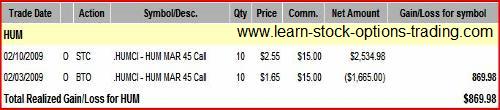
I made $869 and a 52% return on my money in 8 days.
That's the power of stock options trading!
If I were looking to earn a better return on my money than my mutual funds, then I'd be done right here. I wouldn't have to make another trade for the rest of the year.
Heck, I could take two years off and still beat my mutual fund. I'm joking but I think you get my point.
And if you are "not" earning the types of returns shown above then I highly suggest you practice the strategy taught in this web based course.
Please proceed to the next lesson to try out the 10-Minute Strategy yourself.
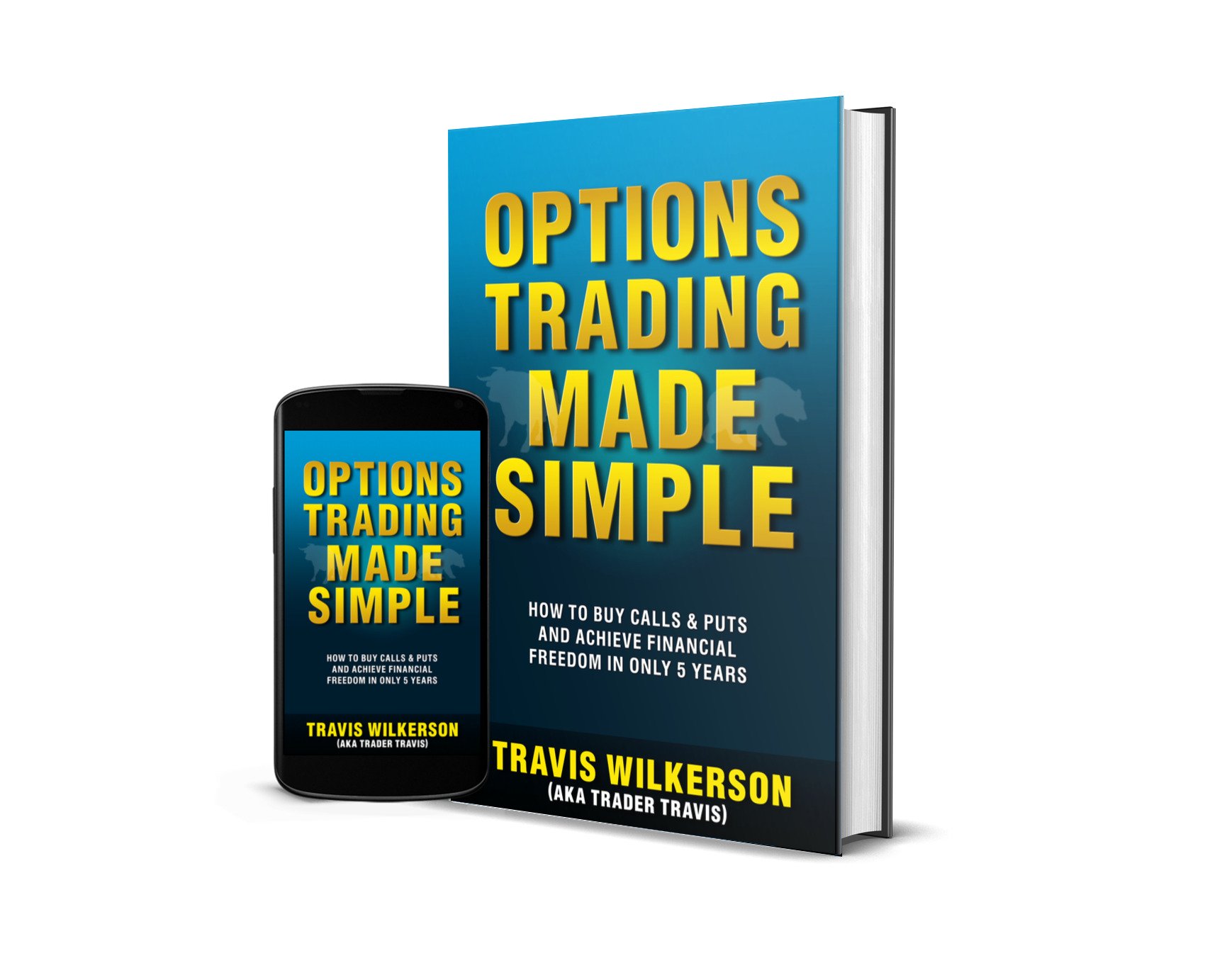
The Passive Stock Options Trading Book Series
Discover how to achieve financial freedom in only 5 years...
Read what others have to say about the book. [Amazon affiliate link]
If You're Looking For A Reliable Lower Risk Way To Be
Profitable With Options, Try The "Buffett Strategy"...
I don't know what has brought you to my page. Maybe you are interested in options to help you reduce the risk of your other stock market holdings.
Maybe you are looking for a way to generate a little additional income for retirement. Or maybe you've just heard about options, you're not sure what they are, and you want a simple step-by-step guide to understanding them and getting started with them.
I have no idea if options are even right for you, but I do promise to show you what has worked for me and the exact steps I've taken to use them to earn additional income, protect my investments, and to experience freedom in my life.
If you want to learn more, I invite you to download a FREE video case study on how to trade options like Warren Buffett.
Inside you will discover...
- How investors pay me money to buy their stock.
- How "combining option selling with option buying" resulted in a 60% growth of my account.
- The "Family Freedom Fund" strategy I use to beat the market each year (I'm an experienced investor so your results may vary).
- And lastly, there is a high risk way to trade options and a low risk way. You'll discover a low risk "sleep well at night" method of investing.
Fill in your details below to download your FREE case study. Along with your case study, you'll also get my daily emails where I share my favorite option trading strategies, examples of the trades I'm currently in, and ways to protect your investments in any market.
Wealth Building Resources
Free Video Case Study (Newsletter)
Options Trading Made Simple Book (My Kindle book)
Options Wealth Academy (High End Training Program co-founded by Travis)
Free Options Course Learning Modules
|
Module 1: Option Basics |
Module 2: Option Value |
Module 3: Basic Strategies |
|
Module 4: Stock Charts |
Module 5: Technical Indicators |
Module 6: The 7-step process I use to trade stock options |
Learn Stock Options Trading Home Page
